Is AI Trading Legit? How We Test Our Signals Before You See Them
 Nizar Assanie
Is AI trading legit? Yes: using AI to pick or place trades is legal, and many real firms do it, but a large share of the products sold as "AI trading" are scams. The question to ask is not whether AI trading is real, but whether one provider can prove its own claims.
AI trading means using statistical or machine-learning models, trained on past market data, to generate trade ideas or place orders. A legit AI trading service is one you can check: who runs it, where your money sits, and what its trades really did, losses included.
This guide is for self-directed investors weighing an AI trading app, bot or signal service. You will learn how to spot a fake platform, how TruthSayer AI tests a model before its signals reach you, and how to run a five-step check on any provider before you pay or deposit a cent.
Key takeaways
AI trading is legal, but fake trading platforms are one of the biggest fraud categories: Americans reported losing $7.9 billion to investment scams in 2025, about half of all fraud losses reported to the FTC.
The FBI's 2025 Internet Crime Report included an AI section for the first time, counting 22,364 AI-related complaints with losses of nearly $893 million.
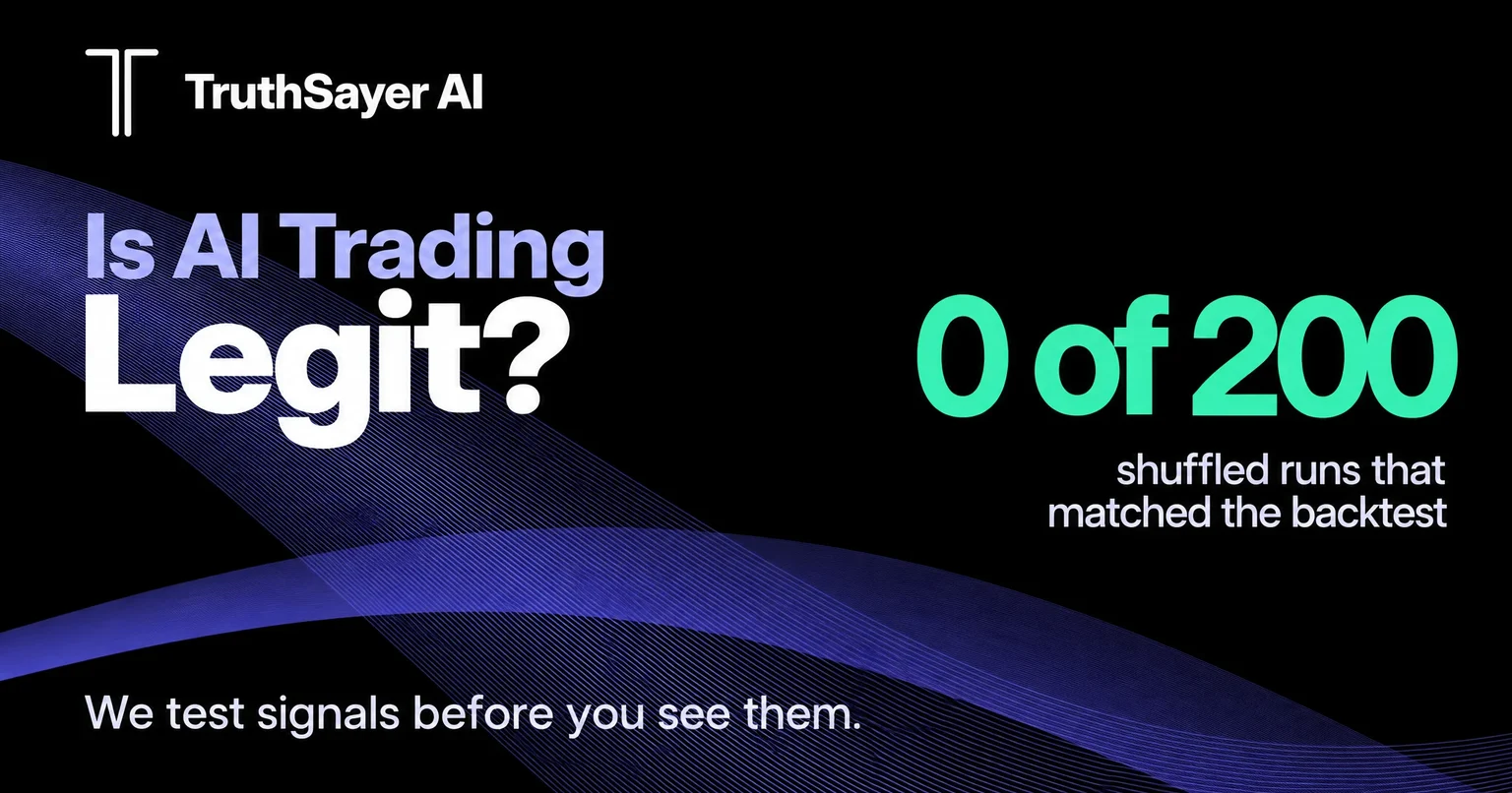
A legit AI model should beat chance on data it never saw: in a TruthSayer AI research backtest, Dark Pools AI© scored 62.7% accuracy on held-back data against a 50.9% baseline, and 0 of 200 shuffled-data runs matched the real model.
Testing should remove signals, not just add them: in the same research backtest, signals where the price was flat won 49.0% of the time and were dropped.
Honest live results include losses and weak spots: on November 7, 2026, TruthSayer's Earnings AI© showed 31.85% since inception against 35.09% for the S&P 500 over the same dates.
What is AI trading, and how does it work?
AI trading uses models that learn patterns from past prices, volumes, filings and other market data, then turn those patterns into a decision: buy, sell, or do nothing. The model is only as good as the data it learned from and the tests it passed.
Most products sold as AI trading fall into five types. The type tells you what the AI does and how much control you keep:
Signal apps. The app sends an alert with an entry and an exit, and you decide whether to place the trade in your own brokerage. TruthSayer AI is a signal app.
Stock scores and scanners. The app ranks or flags stocks, and you do the rest.
Auto-trading bots. The software places orders for you, either in a brokerage account you connect or on a platform that holds your money.
AI chatbots. General tools that answer questions about stocks but do not test or trade anything.
A backtest runs a model on past data to see how it would have done. A holdout test scores the model on a slice of data it never saw while it was built. A live-traded result comes from real orders in a funded account. Each step is harder to fake than the one before.
Is AI trading legit, legal and real in 2026?
AI trading is legal in the US, Canada, the UK and Australia. Rules do not ban software that picks trades; they ban lying about it, handling other people's money without registration, and promising returns no one can deliver.
"Legit" really means three separate things, and a provider has to pass all three:
Legal. The company is real, named and, if it holds your money or trades for you, registered with the right regulator.
Honest. Its results come from real trades, not demo accounts or numbers typed into a dashboard.
Effective. Its model has an edge you can see in tests on unseen data and in live results over time.
Most scams fail the first two. Legal products are judged on the third, where buyers get the least evidence.
Is AI trading real or fake?
The technology is real; many of the platforms are fake. US consumers reported $7.9 billion in investment scam losses to the FTC in 2025, more than double the $3.8 billion reported for 2022.
In the FTC's March 2026 testimony, investment scams made up about half of all reported fraud losses, and the average individual investment scam loss was more than $10,000.
Reported US investment scam losses, 2022 to 2025
Regulators now name AI directly. The FBI's Internet Crime Complaint Center added its first AI section in its 2025 report, with 22,364 complaints and nearly $893 million in losses.
The Alberta Securities Commission warned on November 3, 2026 that fake AI platforms show rising balances that "are only numbers on a screen and are not proof that any trading took place."
Real cases show the pattern. These are enforcement actions with court or regulator figures:
| Case | What was claimed | What was found | Outcome |
|---|---|---|---|
| Mirror Trading International (CFTC) | An AI-style bot trading forex for members | No real bot; account statements came from demo accounts. 29,421 bitcoin worth over $1.73 billion taken from at least 23,000 people | Court ordered over $1.7 billion in restitution plus a $1.7 billion penalty (2023) |
| Delphia (SEC) | Used client data in its AI to predict which companies would succeed | Did not have the AI abilities it advertised | $225,000 civil penalty (March 2024) |
| Global Predictions (SEC) | "First regulated AI financial advisor" | False and misleading claims, including about its AI | $175,000 civil penalty (March 2024) |
"Investment advisers should not mislead the public by saying they are using an AI model when they are not. Such AI washing hurts investors."
— Gary Gensler, Chair, US Securities and Exchange Commission (2024)
Is AI trading safe?
AI trading is as safe as the setup around it. Your money is safest when it stays in your own account at a regulated brokerage and you approve each trade. Risk climbs when software trades for you, and it is highest when you send money to the platform itself, because that is how most scams take funds.
Even a legit model loses trades. On November 7, 2026, TruthSayer's three live trade lists marked 45, 107 and 366 trades as closed losses. Safe means you can see and size those losses, not that they never happen.
How can you tell if an AI trading platform is a scam?
You can rule out most scams in minutes, because they repeat the same signs. The CFTC, FINRA, NASAA, the SEC and Canada's securities regulators all list them:
Guaranteed or very high returns. The CFTC's AI trading bot advisory specifically warns about claims of 100 percent "win" rates.
You must deposit money on their site. Especially in crypto, by wire, or through a "manager" who contacted you first.
Fees or taxes to withdraw. A legit firm does not ask for more money to release yours.
No named people or registration. FINRA's July 2025 alert tells investors to "disregard claims lacking specifics or audited proof."
Pressure and secrecy. Limited spots, countdown timers, or chats that move to WhatsApp or Telegram.
Only screenshots of winners. No full trade list, no losses, no dates.
Use this decision guide when a provider passes the basic checks but you are still unsure:
| Check | Good sign | Average | Warning sign |
|---|---|---|---|
| Where your money sits | Your own regulated brokerage | Connected brokerage, bot places trades | Deposits to the platform or a "manager" |
| Track record | Live trades with dates, prices and losses | Monthly summary only | Screenshots, demo accounts or backtests only |
| Testing | Results on unseen data and against chance | Backtest with costs | "Proprietary AI," no detail |
| Benchmark | Compared with the S&P 500 over the same dates | Compared over a cherry-picked window | No benchmark at all |
| Promises | Past results with risks stated | Vague "high accuracy" | Guaranteed or 100% win rate |
Before you pay anyone who will hold or trade your money, look them up on FINRA BrokerCheck or Investor.gov in the US, or the National Registration Search in Canada. A signal app that never touches your money does not need to be a broker, but it should still name its company and its people.
How do you check one AI trade from alert to exit?
The fastest way to test whether an AI trading service is legit is to audit one trade yourself. Here is a real closed trade from TruthSayer's live Valuations AI© list, read on November 7, 2026:
Find the trade. Zscaler (ZS), long. Entry $184.83 on August 14, 2026. Exit $230.72 on November 2, 2026. Held 80 days.
Check the math. $230.72 minus $184.83 is a $45.89 gain per share. $45.89 divided by $184.83 is a 24.83% raw return.
Compare with the published figure. The trade list shows +24.56%, 0.27 points below the raw price change. Ask any provider what its published returns include, such as costs or exact fill prices, and expect a clear answer.
Check the prices. Pull up Zscaler's chart for those two dates and confirm the stock traded near those levels.
Size it. With 5% position sizing on a $10,000 account, you would put $500 into the trade. $500 times 24.56% is $122.80, or 1.23% of the account.
One winner proves nothing on its own, so repeat the check on three losing trades. Our stock profit calculator does the math for any entry and exit.
How does TruthSayer test its signals before you see them?
Every model at TruthSayer AI has to pass two kinds of proof: statistical tests in research, then live trading in a funded account. Here is the research side for Dark Pools AI©, our model that tracks large institutional trades. These are research backtest figures, before trading costs and slippage, and they measure different things from the live results further down.
We retrained the model on 483 S&P 500 stocks with about two years of data. We locked away the final 20% of the data (1,105 observations) and built everything on the first 80% (4,420 observations).
| Test (research backtest) | What it asks | Result |
|---|---|---|
| Unseen data | Does the model still work on data it never saw? | 62.7% accuracy vs 50.9% baseline (65.5% in training) |
| Chance check | How likely is 62.7% by luck? | p = 1.4 × 10⁻¹⁵ |
| Strictest filter on unseen data | Does the tightest setting hold up? | 68.5% win rate over 54 trades, p = 0.022 |
| Shuffle test | Can random labels do as well? | Real model 65.0%; shuffled runs averaged 51.3%, best 52.6%; 0 of 200 matched |
Is AI trading legit? Dark Pools AI research backtest vs random chance
The shuffle test is the one we care about most. We scrambled the outcomes the model learned from and rebuilt it 200 times. If the model only memorized noise, some of those random versions would score as well. None came close.
Which signals get thrown out?
A test that never rejects anything is not a test. We split signals by whether the price had moved or the price was flat when the signal fired, and required both a t-test and a binomial test to pass at p < 0.05.
| Group, strictest filter (research backtest) | Trades | Win rate | Average return | Tests |
|---|---|---|---|---|
| Price had moved | 165 | 72.1% | +0.92% | Passed (t-test p = 1.7 × 10⁻⁹, binomial p = 6.1 × 10⁻⁹) |
| Price was flat | 304 | 49.0% | +0.08% | Failed (p = 0.44 and 0.66) |
Mixing both groups would have diluted the result to a 54.0% win rate and +0.25% per trade. So the flat-price signals do not reach you. The edge also had to hold when we loosened the filter, which it did at every setting we tested:
Dark Pools AI research backtest: win rate by filter, and the group we dropped
Dark blue: the filter we use. Light blue: other filters tested. Red: the group we dropped.
Does one big trade drive the result?
No. With outlier trades left in, the strictest filter showed 173 trades at a 71.7% win rate; with them removed, 165 trades at 72.1%. The result barely moved.
We also checked whether signals on the same day were just copies of one bet: across 84 same-day pairs, the correlation was +0.10, and they pointed the same way 64.3% of the time against 50% by chance.
These research backtest figures cover one model, about two years of S&P 500 data and a set of filters, before trading costs and slippage. A research backtest can differ from live trading, which is why we publish live results separately and never mix the two.
How does TruthSayer AI use this in live trading?
A model that passes research then has to trade real money. Every alert our models generate is traded in a live funded account before you see it. TruthSayer AI does not hold your money or place trades for you; you act, or not, in your own brokerage.
Here is what the live product pages showed on November 7, 2026:
| Live model (truthsayer.com) | ROI since inception | S&P 500, same dates | Win rate | Average hold | Closed losses listed |
|---|---|---|---|---|---|
| Valuations AI© | 77.39% | 28.51% | 72.1% | 78 days | 45 |
| Dark Pools AI© | 33.33% | 26.07% | 65.7% | 45 days | 107 |
| Earnings AI© | 31.85% | 35.09% | 72.8% | 29 days | 366 |
Two of three models were ahead of the S&P 500 on that date, and one was behind. We show the laggard because a track record that only shows winners is the first thing a scam would do.
Our performance reporting was independently verified for compliance with the GIPS® standards for September 1, 2024 to June 30, 2026; the verifier's reports are on our GIPS page, and our guide to GIPS compliance explains what that means.
Note that research and live win rates measure different things. The 72.1% research figure is a filtered backtest result; the 65.7% live figure for Dark Pools AI© covers every live alert since inception.
We used live figures only from TruthSayer's own product pages, read on November 7, 2026, and research figures only from our statistical validation report. Outside figures come from the FTC, FBI, SEC, CFTC, Canadian regulators and S&P Dow Jones Indices, each linked in the sources. We did not use app store reviews, because review claims are not a track record.
How does AI trading compare with the alternatives?
An AI trading service has to beat what you could do without it. Beating the market is hard for professionals too: SPIVA found that 79% of active US large-cap funds trailed the S&P 500 in 2025, and 85.59% did over 10 years.
| Option | Who decides trades | Where money sits | Proof you can check | Main risk |
|---|---|---|---|---|
| Do it yourself | You | Your brokerage | Your own records | Time and bias |
| Stock newsletter | You, from picks | Your brokerage | Varies; often picks without exits | Hidden losers |
| AI signal app with live trades | You, from alerts | Your brokerage | Live trade list with losses | Model can stop working |
| Auto-trading bot | Software | Connected account or platform | Often backtests only | Fast losses; custody scams |
| Index fund | No one; tracks the index | Your brokerage | Index data | Market falls |
An index fund is the honest default. An AI signal app is worth paying for only if its live results beat that default by more than its cost.
Best for
Self-directed investors who hold for weeks. Signals with entry windows of hours or days, and holds of about a month or longer, suit people who check their account once or twice a day.
Skeptics who want to audit. If you will read the trade list and run the worked example above, a service with full live records gives you something to work with.
Not right for
Anyone who needs this money soon. Every model here has losing trades.
Day traders. TruthSayer's average holds run from 29 to 78 days.
People looking for a hands-off income. A signal still needs you to place, size and track each trade.
What does AI trading cost, and how much time does it take?
Cost matters most on small accounts. TruthSayer's paid plan costs $5.99 a month billed annually ($71.88 a year) or $10.99 a month, after a 7-day free trial, as listed on November 7, 2026. On a $10,000 account, $71.88 is 0.72% a year. A scam costs far more: the FTC put the average individual investment scam loss above $10,000 in 2025.
Time depends on the signal's entry window. On TruthSayer's pages, Valuations AI© gives 1 to 2 days to enter, Earnings AI© 1 to 4 hours and Dark Pools AI© 1 to 2 hours. Checking a provider with the steps below takes an afternoon.
Taxes count too. In the US, gains on stocks held one year or less, like the 80-day Zscaler trade, are taxed as short-term gains at your ordinary income rate.
What are the risks and common mistakes with AI trading?
The biggest risk is trusting a track record you cannot check. Five mistakes cause most of the damage:
Sending money to the platform. Keep funds in your own brokerage. A request for a "fee" before you can withdraw is the clearest sign of a scam.
Treating a backtest as a track record. Our guide to backtested vs live-traded signals shows the difference.
Chasing win rate. A high win rate can hide large losses. Read how to judge a signal service for the math behind expectancy, the average result per trade.
Oversizing. Putting 30% of an account into one alert turns a normal losing trade into a serious one.
Falling for recovery scams. The FTC warns that people who already lost money get targeted again by fake "recovery" services that charge upfront.
AI also makes scams more convincing. In an Ontario Securities Commission study of more than 2,000 Canadians, participants put 22% more into AI-enhanced scams than ordinary ones. Short warnings before exposure cut that by 10%, and a browser plug-in that flagged risks cut it by 31%.
Is a great backtest proof that AI trading works? The contrarian view
The usual advice is to look for a strong backtest. We think a near-perfect backtest is the weakest proof an AI trading service can offer, because it is the easiest to produce. Run enough versions of a model on past data and one will look brilliant by luck.
"Any perseverant researcher will always be able to find a backtest with a desired Sharpe ratio regardless of the sample length requested."
— David H. Bailey, Jonathan M. Borwein, Marcos López de Prado and Qiji Jim Zhu, Notices of the American Mathematical Society (2014)
That is why our own numbers look modest. A 62.7% result on data the model never saw, which none of 200 random versions could match, says more than a 90% result on data it was built on.
Ask any provider for the unseen-data result and the chance check; if it only has the pretty backtest, treat that as a warning, not a selling point.
How do you check any AI trading service? The TruthSayer Legitimacy Check
Use these five steps on any AI trading app, bot or signal service. Stop at the first step it fails.
Name and registration. Find the company, its location and the people who run it. If it will hold or trade your money, confirm registration on BrokerCheck, Investor.gov or the National Registration Search.
Your money stays with you. Your funds should sit in your own regulated brokerage. Any request to deposit on the platform, send crypto or pay a withdrawal fee ends the check.
Live record with losses. Look for a dated, trade-by-trade list from a funded account, with losing trades shown. Audit one winner and three losers using the worked example above.
Tested on unseen data and against chance. Ask for results on held-back data and a test against random versions of the model. "Proprietary" is not an answer.
Verified, with an honest benchmark. Look for independent verification of reporting and a comparison with the S&P 500 over the same dates, including periods when it lagged.
The bottom line: AI trading is legit as a method, and many products selling it are not. Keep your money in your own brokerage, demand live trades with losses, and ask for proof on unseen data. A provider that passes all five steps has earned a paper trial, not your savings.
What should you do next?
Run the check. Take any AI trading service you are considering through the five steps above.
Paper-trade for 30 days. Log every alert, your entry and exit, and your position size, then compare with the provider's published list.
Compare options. Our guide to the best AI trading app compares prices and features, and our explainer on AI stock signals covers how alerts work.
Learn the terms. The TruthSayer glossary defines dark pools and other terms in this guide.
See the live record. Every Dark Pools AI© trade, losses included, is on its product page.
Frequently asked questions
Is AI trading legal?
Yes. Using AI to choose or place trades is legal in the US, Canada, the UK and Australia. What is illegal is lying about AI, handling client money without registration, or promising returns. In March 2024 the SEC fined two advisers a combined $400,000 for false AI claims.
Can AI predict the stock market?
Not reliably, and not every time. A model can find a small, repeatable edge, such as the 62.7% accuracy on unseen data in TruthSayer's Dark Pools AI© research backtest, against a 50.9% baseline. That still means many wrong calls. Anyone claiming near-perfect prediction is a red flag.
How do I know if an AI trading app is a scam?
Watch for guaranteed returns, 100% win rates, requests to deposit money or crypto on their site, and fees to withdraw. Check registration on BrokerCheck or Canada's National Registration Search. The ASC warned on November 3, 2026 that rising balances on a fake platform prove nothing.
Is AI trading profitable?
Sometimes, and you can only judge it from live results against a benchmark. On November 7, 2026, two of TruthSayer's three live models were ahead of the S&P 500 since inception and one, Earnings AI©, was behind at 31.85% vs 35.09%. Past results do not guarantee future ones.
What should I do after I find a legit AI trading app?
Follow its signals on paper for about 30 days. Log each alert, your prices and position size, and compare with the published trade list. Start real trades small, around 5% of your account per position, and recheck results every quarter.
What if I already sent money to an AI trading scam?
Stop sending money, save every message and receipt, and contact your bank or exchange. In the US, report it to the FTC at ReportFraud.ftc.gov, the FBI at ic3.gov and the SEC; in Canada, to your provincial regulator. Ignore anyone offering to recover funds for a fee.
Sources
- TruthSayer AI, Valuations AI© live results and trade list (accessed November 7, 2026)
- TruthSayer AI, Dark Pools AI© live results and trade list (accessed November 7, 2026)
- TruthSayer AI, Earnings AI© live results and trade list (accessed November 7, 2026)
- TruthSayer AI, GIPS® compliance and verification (verification period September 1, 2024 to June 30, 2026)
- TruthSayer AI, Dark Pool AI Signal Statistical Validation Report, S&P 500 retrain (internal research backtest, summary figures only)
- FTC, testimony before the Joint Economic Committee on the rising scam economy (March 25, 2026)
- FTC, Consumer Sentinel Network News: 2024 fraud losses (March 20, 2025)
- AARP, report on FTC fraud data for 2022 and 2023 (February 9, 2024)
- FTC, Consumer Protection Data Spotlight on social media scams (2026)
- FBI, press release on the 2025 IC3 Internet Crime Report (April 6, 2026)
- CFTC, charges against Mirror Trading International and its CEO (2022)
- CFTC, court order against Mirror Trading International (September 2023)
- CFTC, customer advisory on AI trading bots (January 25, 2024)
- SEC, press release 2024-36 on false AI claims by two investment advisers (March 18, 2024)
- FINRA, investor insight on auto-trading and unregistered entities (July 29, 2025)
- NASAA, Informed Investor Advisory: AI investment scams (September 2, 2026)
- Alberta Securities Commission, investor alert on AI trading scams (November 3, 2026)
- Ontario Securities Commission, Artificial intelligence and retail investing: scams and effective countermeasures (accessed November 7, 2026)
- Bailey, Borwein, López de Prado and Zhu, "Pseudo-Mathematics and Financial Charlatanism," Notices of the AMS (May 2014)
- S&P Dow Jones Indices, SPIVA U.S. Year-End 2025 (March 3, 2026)
This article is for educational purposes only and is not investment advice. Past performance does not guarantee future results.
Nizar Assanie
Nizar is the founder of TruthSayer AI and brings over two decades of experience in quantitative finance, investment analytics, and machine learning. His expertise spans systematic investment strategies, equity valuation, institutional capital flows, and predictive financial modeling. He leads the development of AI-driven investment strategies designed to identify market inefficiencies and optimize risk-adjusted returns.