Margin of Safety: How Much Discount Is Enough?
 Nizar Assanie
A margin of safety is the discount between what you estimate a stock is worth and the price you pay for it. How much margin of safety is enough depends on how sure you are of that estimate: about 20% for a steady, predictable business, and 40% to 50% or more for a cyclical, indebted or unproven one.
The idea comes from Benjamin Graham, the father of value investing. You will make mistakes when you value a company. The margin of safety is the room that lets you be wrong and still not lose money.
This guide is for investors who pick their own stocks. You will learn the formula, see how big a discount professionals demand, follow a real Procter & Gamble example with today's price, and leave with a buy-below price method you can use on any stock.
Key takeaways
Margin of safety = (intrinsic value − price) ÷ intrinsic value, so a stock you value at $100 and buy at $70 has a 30% margin of safety.
Morningstar requires a 20% discount to fair value for a 5-star rating on its lowest-uncertainty stocks and a 75% discount on its extreme-uncertainty stocks.
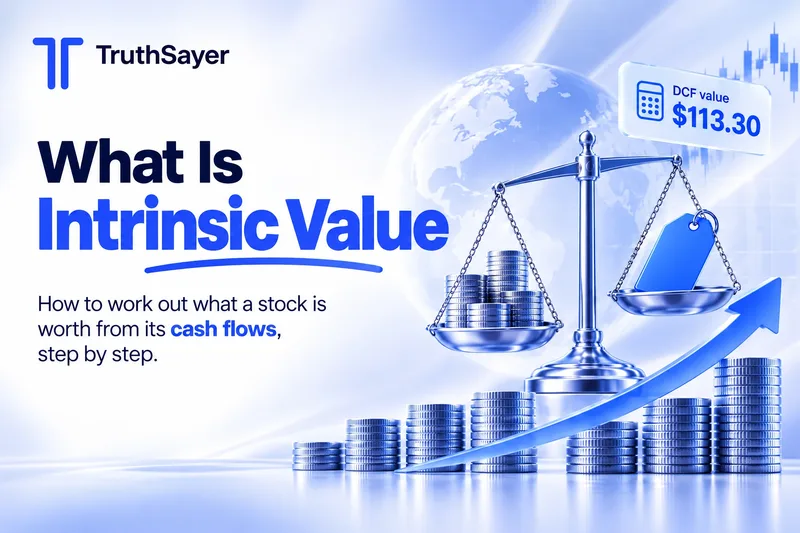
Procter & Gamble closed at $167.32 on November 4, 2026, 47.7% above our base-case DCF value of $113.30, so it had no margin of safety on that estimate.
In our review of 10-K filings, the worst one-year fall in free cash flow over the last decade ranged from 8.7% at Microsoft to a swing from positive to negative at Ford and Exxon Mobil.
A bigger discount needs a bigger rebound to pay off: buying at a 50% margin of safety means the stock has to double to reach fair value.
What is a margin of safety in investing?
A margin of safety in investing is the gap between a stock's estimated intrinsic value and its market price, stated as a percentage of the value. It is a cushion against errors in your forecast, bad luck and market swings.
Benjamin Graham made the margin of safety the central idea of The Intelligent Investor (1949). Warren Buffett, Graham's student at Columbia, explained it with a bridge in his 1984 talk at Columbia Business School:
"You don't try and buy businesses worth $83 million for $80 million. You leave yourself an enormous margin. When you build a bridge, you insist it can carry 30,000 pounds, but you only drive 10,000 pound trucks across it. And that same principle works in investing."
— Warren E. Buffett, Chairman, Berkshire Hathaway, "The Superinvestors of Graham-and-Doddsville" (1984)
Intrinsic value is what a business is worth based on the cash it will produce, discounted to today. Our guide to calculating intrinsic value walks through a full discounted cash flow (DCF) model.
What is margin of safety in accounting?
In accounting, margin of safety means something different: how far sales can fall before a company stops making a profit. The formula is (current sales − break-even sales) ÷ current sales. Illustrative example: a shop with $500,000 of sales and a $400,000 break-even point has a 20% accounting margin of safety. The rest of this guide covers the investing meaning.
How do you calculate margin of safety?
You calculate a margin of safety by subtracting the price from your intrinsic value estimate and dividing by that estimate. The formula has two forms:
Margin of safety (%) = (intrinsic value − price) ÷ intrinsic value
Buy-below price = intrinsic value × (1 − required margin)
Illustrative example: you value a stock at $100. At a price of $70, the margin of safety is ($100 − $70) ÷ $100 = 30%. If you require 25%, your buy-below price is $100 × 0.75 = $75.
Divide by the value, not the price. The same $30 gap is 42.9% of the $70 price, which overstates the cushion. A negative result means the stock trades above your value estimate and has no margin of safety at all.
Why does a bigger discount need a bigger rebound?
A margin of safety is measured as a discount from value, but your gain is measured from the price you paid. The two numbers drift apart fast as the discount grows. The required gain to reach fair value is 1 ÷ (1 − margin) − 1.
| Margin of safety | Price paid for $100 of value | Gain if price reaches value | How wrong your value can be before you lose |
|---|---|---|---|
| 10% | $90 | 11.1% | 10% too high |
| 20% | $80 | 25.0% | 20% too high |
| 30% | $70 | 42.9% | 30% too high |
| 40% | $60 | 66.7% | 40% too high |
| 50% | $50 | 100.0% | 50% too high |
| 75% | $25 | 300.0% | 75% too high |
The table is arithmetic, not a forecast. It shows why a wider margin protects you in two ways: your estimate can be further off, and the upside if you are right is larger.
How much margin of safety is enough?
A margin of safety is enough when it covers the realistic error in your value estimate. That error is small for a stable business and large for a cyclical, leveraged or young one, so the right discount changes from stock to stock.
Morningstar publishes one of the clearest rule sets. Its analysts give every covered stock an Uncertainty Rating, from Low to Extreme, and the rating sets how far the price must fall below Morningstar's fair value estimate before the stock earns 4 or 5 stars.
Margin of safety Morningstar requires, by Uncertainty Rating
Consider buying (4 stars)5 stars
Morningstar says the factors behind the rating include sales predictability, operating and financial leverage, and one-off events such as lawsuits. Since July 2022 the process starts from a suggested rating based on the stock's trailing 12-month volatility, which analysts can override.
What do Buffett and Graham say?
Buffett has never published a fixed percentage. In his 1992 letter to Berkshire Hathaway shareholders, he wrote:
"We insist on a margin of safety in our purchase price. If we calculate the value of a common stock to be only slightly higher than its price, we're not interested in buying. We believe this margin-of-safety principle, so strongly emphasized by Ben Graham, to be the cornerstone of investment success."
— Warren E. Buffett, Chairman, Berkshire Hathaway, 1992 Chairman's Letter (1993)
In the same 1984 Columbia talk, Buffett described buying the Washington Post Company when the market valued it at about $80 million and he judged its assets worth more than $400 million. That is a discount of about 80%, far beyond what most investors will ever see on a large company.
What does margin of safety look like on a real stock?
A real margin of safety calculation starts with a value range, not a single number. Here is Procter & Gamble (PG), using the DCF from our intrinsic value guide, built from P&G's fiscal 2026 10-K, and P&G's closing price of $167.32 on November 4, 2026.
- Start from free cash flow. Operating cash flow $19,556 million − capital expenditures $4,409 million = $15,147 million, or $6.25 per diluted share (2,422.5 million shares).
- Set the discount rate. 10-year Treasury yield 4.91% + beta 0.82 × equity risk premium 4.23% = 8.38%.
- Build three cases. Base case: 3% growth for 10 years, then 2.5% forever, at 8.38% = $113.30. Low case: 10% discount rate, 2% terminal growth = $85.64. High case: 7% discount rate, 3% terminal growth = $161.01.
- Calculate the margin on each case. Base: ($113.30 − $167.32) ÷ $113.30 = −47.7%. High: ($161.01 − $167.32) ÷ $161.01 = −3.9%. Low: ($85.64 − $167.32) ÷ $85.64 = −95.4%.
- Set a buy-below price. P&G's cash flow is steady, so a 20% margin fits, the same discount Morningstar uses for low-uncertainty stocks. $113.30 × 0.80 = $90.64.
- Compare with today. P&G would need to fall 45.8%, from $167.32 to $90.64, to reach that price.
Procter & Gamble: price vs value and buy-below prices (per share)
Even our most generous case, at $161.01, sits below the market price. On these assumptions, P&G has no margin of safety today. The decision is to wait, not to buy and hope.
What growth does the price assume?
A reverse DCF turns the margin of safety into a growth rate. Holding the base-case discount rate and terminal growth fixed, P&G's $167.32 price implies free cash flow growth of 8.06% a year for 10 years. P&G's free cash flow grew 2.8% a year from fiscal 2022 to 2026.
At the $90.64 buy-below price, the implied growth drops to about 0.1% a year. In other words, a 20% margin of safety on P&G means paying a price that works even if its cash flow never grows.
Measure your margin against the low case, not just the base case. A margin that survives your own pessimistic case means the purchase does not depend on your optimistic assumptions being right.
How much do cash flows really swing? Our research
Cash-flow stability is the best single guide to how much margin of safety a stock needs. To measure it, we took operating cash flow minus capital expenditures from each company's last 10 annual reports on SEC EDGAR (9 for Ford) and found the worst one-year fall.
Worst one-year fall in free cash flow, last 10 fiscal years
Three findings stand out:
Large tech and staples were the steadiest. Microsoft's worst year was a fall of 8.7% (fiscal 2023), Apple's 10.6% (fiscal 2023) and Procter & Gamble's 15.0% (fiscal 2025).
"Defensive" did not mean smooth. Coca-Cola's free cash flow fell 51.4% in 2024, from $9,747 million to $4,741 million. Walmart's fell 57.1% in fiscal 2022, from $25,810 million to $11,075 million.
Cyclicals went negative. Exxon Mobil went from +$5,355 million in 2019 to −$2,614 million in 2020. Ford went from +$9,560 million in 2021 to −$13 million in 2022.
A 20% margin would not have covered a single bad year at Exxon Mobil or Ford. That is the practical case for asking 40% to 50% or more on cyclical companies, and for checking a company's own cash-flow history instead of assuming its sector label tells you the risk.
What is a good margin of safety by type of company?
A good margin of safety is one matched to how uncertain the business is. Use this decision guide as a starting point and adjust for debt and for how much of the value sits in the distant future.
| Type of company | Example signs | Margin to require | Warning sign |
|---|---|---|---|
| Stable, predictable | Worst free cash flow fall under 20% in 10 years, low debt | 20%–25% | Price above your high case |
| Average business | Some cyclicality, moderate debt | 30%–35% | Margin only exists in your base case |
| Cyclical or leveraged | Free cash flow has turned negative in a downturn | 40%–50% | Valuing on peak-cycle cash flow |
| Unproven, turnaround or distressed | Losses, one product, refinancing risk | 50%–75% or pass | No credible cash-flow forecast |
The middle row is our default when you are unsure. The ranges mirror the steps in Morningstar's 5-star thresholds and the cash-flow swings in our research above; they are guides, not rules.
How does margin of safety compare with other ways to manage risk?
A margin of safety protects you against valuation error before you buy. Stop-losses, position sizing and diversification protect you after you buy. Most disciplined investors use more than one.
| Method | What it protects against | Best for | Weak spot |
|---|---|---|---|
| Margin of safety | Paying too much for a wrong value estimate | Long-term value investors | Only as good as the value estimate; you may wait years |
| Low P/E screen | Obvious overpricing | Finding candidates quickly | A low P/E can be a falling business; see what a good P/E ratio is |
| Stop-loss or trailing stop | A loss growing too large | Active traders and signal followers | Can sell at the bottom of a normal swing |
| Position sizing | One mistake sinking the portfolio | Everyone | Does not stop the loss on the position itself |
| Index fund | Single-company risk | Investors who do not want to value stocks | No protection from a market-wide fall |
A margin of safety and position sizing work well together. The margin lowers the odds of a loss on each stock; sizing caps how much any one loss can cost.
Which margin of safety approach is best for you?
The best approach depends on your time horizon, how many stocks you follow and how much time you can spend on each.
Best for long-term value investors
Build a three-case DCF for each holding, require 20% to 35% against the base case, and keep a written watchlist of buy-below prices. Expect to buy rarely.
Best for beginners
Start with a simple rule: buy only well-known, profitable companies, require at least 30% below a conservative value, and keep each position to 5% or less of your portfolio.
Best for active traders
Traders usually rely on stops and position size more than on a discount to value. A margin of safety still helps you choose which setups deserve capital.
Who is it not right for?
A margin of safety is a poor fit for day traders, for momentum strategies that buy strength, and for investors who will not build or check a value estimate. Without an honest estimate, the discount means nothing.
What does using a margin of safety cost, and how long does it take?
Using a margin of safety costs little money but a lot of patience. The direct costs are data and time; the hidden cost is the gains you miss while you wait.
Data: free. Annual reports are on SEC EDGAR, the 10-year Treasury yield is on FRED and industry betas are on Aswath Damodaran's NYU pages.
Time: about two to four hours for a first three-case DCF on one company, and less than an hour to update it after each annual report.
Waiting: a 20% margin on P&G today needs a 45.8% price fall. Some stocks never reach your price.
Taxes and fees: lower turnover usually means fewer commissions and more long-term capital gains, which many tax systems treat more lightly than short-term gains.
After you buy, the work shifts to checking whether the value has changed. Recheck the estimate after each annual report, and after any event that changes the business.
What are the common margin of safety mistakes?
The most common margin of safety mistake is applying a big discount to an inflated value. These five errors cause most of the damage:
- Discounting an optimistic estimate. A 40% discount to a value that assumes 20% growth forever protects nothing.
- Confusing cheap with safe. A low P/E or a big price fall is not a margin of safety if the business is shrinking; see our step-by-step guide to undervalued stocks.
- Counting caution twice. Using a high discount rate for risk and then demanding a 50% margin for the same risk can mean you never buy anything.
- Averaging down on autopilot. A falling price adds margin only if the value has not fallen too. Re-estimate the value before you add.
- Ignoring debt. Debt magnifies every error in the value of the business, so leveraged companies need a wider margin.
The honest limit of the concept is that intrinsic value is an estimate. A margin of safety reduces the chance of a permanent loss; it does not remove it.
Is a bigger margin of safety always better? The contrarian view
A bigger margin of safety is not always better, because the deepest discounts are often on the weakest businesses. Buffett learned this himself and said so in his 1989 letter to shareholders:
"It's far better to buy a wonderful company at a fair price than a fair company at a wonderful price."
— Warren E. Buffett, Chairman, Berkshire Hathaway, 1989 Chairman's Letter (1990)
The data supports him. Morningstar asks only a 20% discount for a 5-star rating on its lowest-uncertainty stocks, because their value is easier to pin down. Our cash-flow research shows why: Microsoft's worst free cash flow year in a decade was a fall of 8.7%, while Exxon Mobil's cash flow turned negative.
A stock can also look 60% cheap because its value really did fall. In that case the margin is an illusion. The margin of safety comes from the quality of your estimate, not the size of the discount.
How should you apply it? The TruthSayer Margin-of-Safety Check
The TruthSayer Margin-of-Safety Check is a six-step routine that turns the idea into a written buy-below price. Run it before every purchase.
- Value the stock as a range. Build a low, base and high case, changing the discount rate and long-run growth.
- Rate the uncertainty. Find the worst one-year fall in free cash flow over the last 10 annual reports, and note debt.
- Pick the required margin. 20%–25% for stable, 30%–35% for average, 40%–50% for cyclical or leveraged, more or pass for unproven.
- Write the buy-below price. Base value × (1 − margin), and check it is at or below your low case.
- Check the implied growth. Run a reverse DCF at the buy-below price and confirm the growth it implies is easy for the business to beat.
- Set size and exit rules first. Cap the position, decide when you will re-estimate value, and only add on a fall after re-estimating.
How does TruthSayer AI use margin of safety?
TruthSayer's Valuations AI estimates a fair value for each stock it covers and signals when a stock trades below it. Every signal is traded in a funded account before members see it, with fixed risk rules that work like a margin of safety:
5% position size per trade, so one wrong value estimate cannot sink the account.
Averaging down only after a fall of 2 to 3 standard deviations below fair value on core trades, never on an ordinary dip.
A trailing stop at 3× the average true range on non-core trades, which caps losses when the estimate is wrong.
The record shows why those rules matter. From September 25, 2024 to November 2, 2026, Valuations AI closed 74 long stock trades on "undervalued" signals: 57 winners and 17 losers, an average win of 18.80% and an average loss of 17.86%. Three of the losses were deeper than 40%. Buying below fair value lowers the odds of a loss; it does not prevent one.
The averaging-down rule fired once in that period: Akamai, added at $99.27 on November 8, 2024 and closed at $88.99 on February 21, 2025, a 10.56% loss. As of November 5, 2026, the Valuations AI page shows a 78.33% return since inception against 34.36% for the S&P 500, with a 72.9% win rate across all closed stock trades. TruthSayer AI claims compliance with GIPS®, the global performance reporting standard; see our GIPS reports and verification.
The margin ranges in this article come from Morningstar's published 5-star thresholds and our own count of free cash flow swings in 10-K filings. The P&G figures come from one DCF with stated assumptions; different assumptions, or a different model such as Valuations AI, can give a different value. The trade statistics are our own calculation from the published Valuations AI trade list.
What should you do after you set a margin of safety?
After you set a margin of safety, write down the buy-below price and the reason the market might be wrong, then wait. When a stock reaches your price, re-check the value before you buy.
Build the value range first with our guide to intrinsic value and DCF.
Screen for candidates with how to find undervalued stocks and check multiples with what a good P/E ratio is.
If you follow a signal service, test its record with win rate, expectancy and drawdown, and see why live-traded results beat backtests as proof.
Work out the gain or loss on a position with our stock profit calculator, and look up terms in the investing glossary.
See current fair-value signals and every closed trade on Valuations AI.
The bottom line: A margin of safety is the discount that lets you be wrong and still not lose money, and the right size depends on how uncertain the business is: about 20% for a steady company, 40% to 50% or more for a cyclical or indebted one. Run the TruthSayer Margin-of-Safety Check before every purchase: value the stock as a range, rate its uncertainty, and write down a buy-below price. If the price never gets there, the right move is to wait.
Frequently asked questions
What is a good margin of safety for stocks?
A good margin of safety for stocks is usually 20% to 35% for established, profitable companies and 40% to 50% or more for cyclical or unproven ones. Morningstar's 5-star thresholds run from a 20% discount for low-uncertainty stocks to 75% for extreme-uncertainty stocks. Match the margin to how predictable the company's cash flow has been.
What does a 30% margin of safety mean?
A 30% margin of safety means you pay $70 for a stock you value at $100. Your value estimate can be up to 30% too high before you lose money, and if the price rises to your estimate you gain 42.9%. The percentage is always measured against the value estimate, not the price.
Can a margin of safety be negative?
Yes, a negative margin of safety means the stock trades above your value estimate. Procter & Gamble closed at $167.32 on November 4, 2026, against our base-case DCF value of $113.30, a margin of safety of −47.7%. A negative margin is a signal to wait or to recheck your assumptions.
What should I do after a stock reaches my buy-below price?
After a stock reaches your buy-below price, re-estimate its value before buying, because the price may have fallen for a reason that lowers the value too. Check the latest 10-Q or 10-K, confirm the reason the market is wrong, then buy within your position limit, such as 5% of the portfolio.
How often should I recheck my margin of safety?
Recheck your margin of safety after every annual report, usually once a year, and after any major event such as a profit warning, an acquisition or a big change in interest rates. The 10-year Treasury yield, a common discount-rate input, was 4.95% on November 3, 2026, so rate changes can move values quickly.
Should I sell when the margin of safety disappears?
Not automatically. When the price reaches your value estimate, the margin of safety is gone, so the decision becomes whether a better opportunity exists for the money. Many value investors sell or trim at or above fair value; Morningstar's 1-star threshold for low-uncertainty stocks is a 25% premium to fair value.
Sources
- Morningstar, An Introduction to the Morningstar Uncertainty Rating (Sep 29, 2022)
- Morningstar, How to Measure a Stock's Uncertainty (Sep 27, 2024)
- Morningstar, Equity Research Methodology (Sep 2022)
- Warren E. Buffett, The Superinvestors of Graham-and-Doddsville, Columbia Business School (1984)
- Berkshire Hathaway, 1992 Chairman's Letter (Mar 1, 1993)
- Berkshire Hathaway, 1989 Chairman's Letter (Mar 2, 1990)
- Procter & Gamble 10-K and 10-Q filings, SEC EDGAR (FY2026 10-K filed Aug 4, 2026)
- SEC EDGAR company filings and XBRL data for Microsoft, Apple, Coca-Cola, Walmart, Ford and Exxon Mobil (10-K filings through Nov 3, 2026)
- FRED, 10-Year Treasury Constant Maturity Rate (DGS10) (Nov 3, 2026)
- Aswath Damodaran, Historical Implied Equity Risk Premiums, NYU Stern (Jan 2026)
- TruthSayer AI, Valuations AI performance and trade list (Nov 5, 2026)
This article is for educational purposes only and is not investment advice. Past performance does not guarantee future results.
Nizar Assanie
Nizar is the founder of TruthSayer AI and brings over two decades of experience in quantitative finance, investment analytics, and machine learning. His expertise spans systematic investment strategies, equity valuation, institutional capital flows, and predictive financial modeling. He leads the development of AI-driven investment strategies designed to identify market inefficiencies and optimize risk-adjusted returns.