Forward Guidance: Why It Moves Stocks More Than Results
 Joan Sacdalan
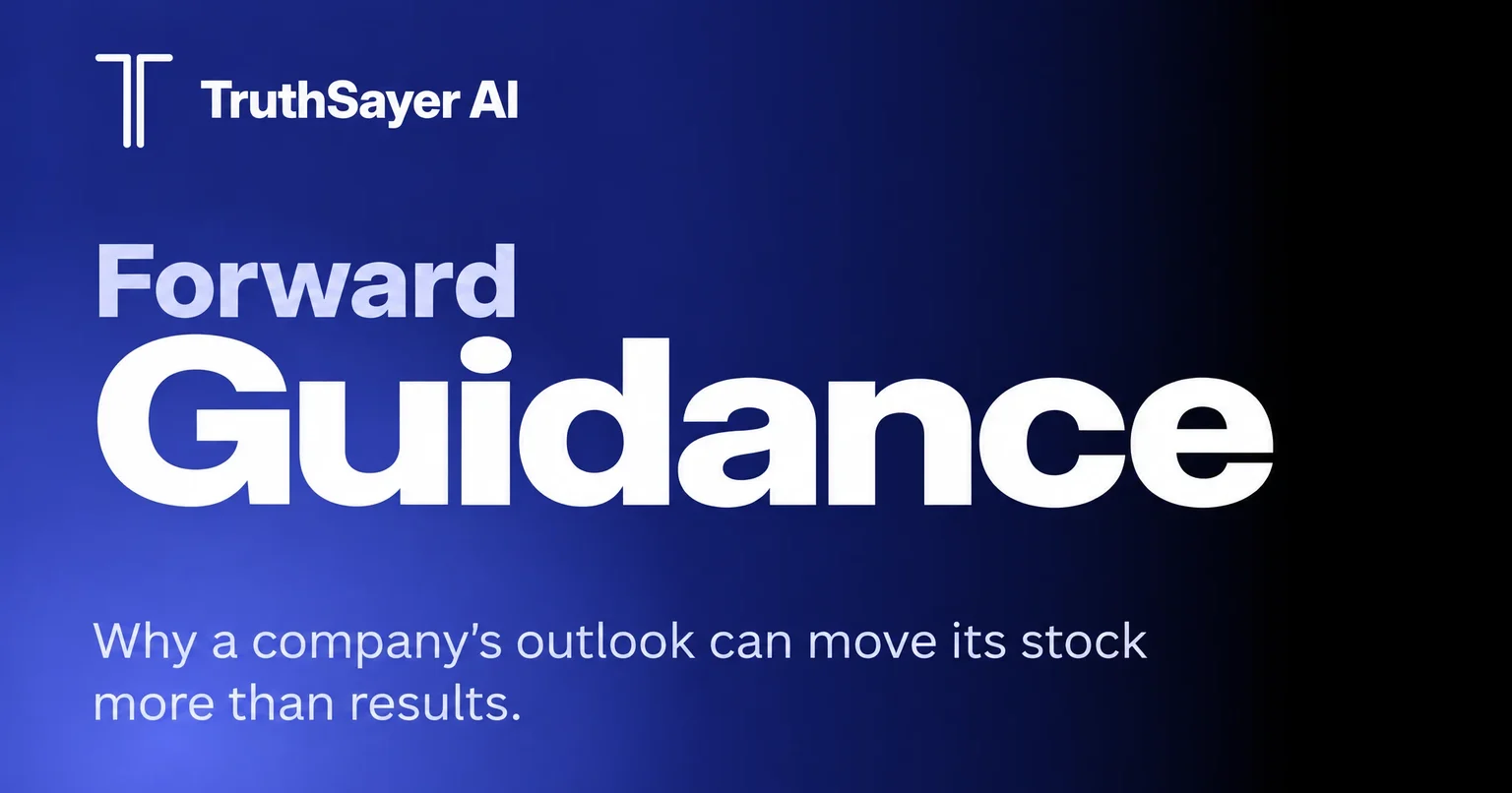
Forward guidance is a company's own forecast of its future results, usually revenue, earnings per share (EPS) and margins for the next quarter or year. Forward guidance often moves a stock more than the quarter just reported, because the share price reflects expected future profits, and guidance resets those expectations overnight.
In plain terms, the earnings report tells you what already happened, and the guidance tells you what management thinks happens next. When Intel beat its third-quarter 2026 EPS estimate by 26.8% but guided the fourth quarter well below forecasts, the stock fell 28.6% the next day.
This guide is for retail investors who pick their own stocks and hold through earnings. You will learn to find guidance in a filing, measure it against consensus, and tell a real warning from noise.
Key takeaways
Forward guidance is a voluntary forecast that management publishes, usually in the earnings release filed with the SEC on Form 8-K under Item 2.02.
The number that moves a stock is the gap between the guidance midpoint and the analyst consensus, not the guidance alone.
In Q3 2026, S&P 500 companies that beat EPS estimates gained only 0.8% on average around the report, according to FactSet, so a beat alone told investors little.
In our check of eight Q3 2026 reports, all five companies that guided below consensus fell the next day, by 13.5% on average; the three that raised guidance were mixed.
Only 43% of S&P 500 companies that guided on Q4 2026 issued negative EPS guidance, below the 5-year average of 60%, according to FactSet on Nov 6, 2026.
What is forward guidance in stocks?
Forward guidance is management's public estimate of a future financial result. Intel's October 29, 2026 release, for example, forecast fourth-quarter revenue of $15.0 billion to $16.0 billion and non-GAAP EPS of $0.25.
Forward guidance is voluntary. No US rule requires a company to forecast anything, and many large companies choose not to. FCLTGlobal, a nonprofit that studies long-term investing, found the share of S&P 500 companies giving quarterly EPS guidance fell from 36.0% in 2010 to 27.8% in 2016.
Consensus is the average forecast of the analysts who cover a stock, collected by data firms such as LSEG and FactSet. Guidance is the company's forecast. The gap between the two is what traders react to.
What types of forward guidance are there?
Quarterly guidance covers the next three months. Intel, Reddit and Pinterest gave fourth-quarter revenue ranges in October 2026.
Annual guidance covers the fiscal year. It is more common: FactSet counted 269 S&P 500 companies with full-year EPS guidance on Nov 6, 2026, against 75 with Q4 guidance.
Metric guidance covers a line other than EPS, such as revenue, gross margin, operating income, capital spending or bookings. Netflix cut its 2026 advertising revenue forecast to about $2.7 billion from about $3 billion.
Long-range targets cover several years, such as Akamai's 2028 revenue target above $7.0 billion.
Where do you find a company's guidance?
Most US companies publish guidance in the earnings press release, which they file with the SEC as an exhibit to Form 8-K under Item 2.02, "Results of Operations and Financial Condition." The section is usually headed "Outlook" or "Business Outlook" and sits after the results tables.
Regulation FD, adopted by the SEC in 2000, requires companies to share material information with all investors at the same time, so guidance cannot be whispered to a few analysts first.
Why does forward guidance move stocks more than results?
Forward guidance moves stocks more than results because the reported quarter is already mostly expected, while guidance changes the forecast for every future quarter. A stock price is a bet on future cash flows, and guidance is management's update to that bet.
The data for Q3 2026 shows how little a beat alone was worth. By Nov 6, 2026, 84% of reporting S&P 500 companies had beaten EPS estimates, according to FactSet, yet those companies gained only 0.8% on average from two days before to two days after the report. The five-year average reward for a beat is 0.9%.
When most companies beat, the surprise sits in the outlook instead. FactSet reported that Q4 2026 guidance was unusually positive, with 43 companies guiding above consensus and 32 below.
Negative forward guidance: share of S&P 500 EPS guidance below consensus
Academic research points the same way. Feldman, Lazer and Livnat (2003) studied guidance after Regulation FD and found that guidance released between earnings reports, often a profit warning, drew significant negative reactions. They also found reactions were stronger for revenue guidance than for earnings guidance.
Our guide to the earnings surprise covers how the beat itself is scored. This article focuses on the second half of the release, the outlook.
How did Intel's forward guidance erase a 27% earnings beat?
Intel's third-quarter 2026 report shows forward guidance outweighing results. Intel beat the EPS consensus by 26.8%, matched revenue estimates, then guided the fourth quarter far below forecasts. The stock fell 28.6% the next day.
Here is the teardown, using Intel's earnings release filed on Form 8-K on October 29, 2026, the LSEG consensus reported by CNBC and Yahoo Finance, and Intrinio closing prices.
- Score the quarter. Intel reported non-GAAP EPS of $0.52 against a $0.41 consensus. $0.52 ÷ $0.41 − 1 = +26.8%. Revenue was $16.5 billion, in line with the $16.5 billion estimate.
- Find the outlook table. Under "Business Outlook," Intel forecast Q4 revenue of $15.0 billion to $16.0 billion and non-GAAP EPS of $0.25, with GAAP EPS of $0.10.
- Take the midpoint. ($15.0 billion + $16.0 billion) ÷ 2 = $15.5 billion. Intel states that its EPS outlook is based on that midpoint.
- Compare with consensus. Analysts expected $17.1 billion of Q4 revenue and $0.43 of EPS, according to LSEG. $15.5 billion ÷ $17.1 billion − 1 = −9.4%. $0.25 ÷ $0.43 − 1 = −41.9%.
- Read management's reason. Intel's CFO pointed to a weaker PC market, a factor that would last beyond one quarter (quote below).
- Measure the reaction. Intel closed at $92.08 on October 29 and $65.79 on October 30. $65.79 ÷ $92.08 − 1 = −28.6%. The SPDR S&P 500 ETF (SPY) fell 1.8% that day, so about 26.8 points of the drop were Intel's own.
"Looking ahead, we see the PC slowdown continuing at least through the first half of next year, but we remain optimistic about the opportunities across our broader portfolio."
— David Zinsner, Chief Financial Officer, Intel Corporation (October 29, 2026)
Intel Q3 2026: results beat, forward guidance missed
The headline said "Intel tops Q3 earnings estimates." The outlook table said the next quarter would earn about 42% less than analysts expected. Read the outlook first.
What happened to stocks that guided below consensus in Q3 2026?
In our check of eight Q3 2026 reports, every company whose guidance landed below consensus fell the next day, with an average move of −13.5%. The three companies that raised guidance averaged −2.3%, because one of them, CoStar, fell 13.7%.
Method. We took companies whose Q3 2026 guidance and consensus were both published in an earnings release and a named news report between October 20 and November 3, 2026. For each, we measured the close before the report to the first full-session close after it, using Intrinio prices, and subtracted the SPY move on the same day. We excluded Akamai, which fell 9.5% in the session before its report, so its next-day move could not be tied to guidance alone.
Forward guidance vs the next-day stock move, Q3 2026 reports
Guidance below consensusGuidance raised
| Company | EPS vs consensus | Guidance vs consensus | Next-day move | Move minus SPY |
|---|---|---|---|---|
| Beat ($1.40 vs $1.33) | Q4 revenue midpoint $1.015B vs $1.05B | −29.4% | −27.6 pts | |
| Intel | Beat ($0.52 vs $0.41) | Q4 revenue $15.5B vs $17.1B; EPS $0.25 vs $0.43 | −28.6% | −26.8 pts |
| Netflix | Beat ($0.87 vs $0.82) | 2026 revenue $51.1B vs $51.2B; ad revenue cut to ~$2.7B | −5.3% | −5.8 pts |
| Miss ($0.46 vs $0.48) | Q4 revenue $1.425B–$1.475B vs $1.52B | −2.7% | −0.9 pts | |
| Amazon | Miss ($1.89 vs $1.96) | Q4 sales and operating income midpoints below consensus | −1.6% | +0.2 pts |
| CoStar | Beat ($0.38 vs $0.34) | Raised 2026 revenue to $3.75B–$3.77B | −13.7% | −14.1 pts |
| DigitalOcean | Beat ($0.45 vs $0.32) | Q4 revenue $348M–$351M vs $333.4M | +0.7% | +0.4 pts |
| Rivian | Beat | Raised 2026 outlook | +6.2% | +8.0 pts |
The biggest drops, Reddit and Intel, came from companies that beat EPS. The size of the guidance gap also mattered: Netflix missed revenue consensus by only about 0.2% and fell 5.3%, while Intel missed by 9.4% and fell 28.6%.
Amazon's 1.6% fall matched the market's 1.8% drop that day. Eight reports are a small sample. Treat this table as a worked illustration of the pattern, not a statistical test.
Always divide the guidance midpoint by the consensus and write down the percentage. A $0.10 EPS gap means little for a stock earning $15 a share and a great deal for one earning $0.40.
How do you tell good forward guidance from bad?
Good forward guidance sits above consensus, and bad forward guidance sits below it. The direction of the change from the company's own prior range adds a second layer, and a withdrawal is usually the worst signal of all.
| What the company does | How the market usually reads it | Q3 2026 example | What to check next |
|---|---|---|---|
| Raises guidance above consensus | Positive, if expectations were not higher still | DigitalOcean, Rivian | Whether the stock already ran up before the report |
| Raises guidance, but not to consensus | Often negative: "up" is still below what was priced in | Check midpoints, not the word "raised" | The gap in percent |
| Reaffirms guidance | Neutral, unless results were weak | Amazon reaffirmed its $220B capex plan | Whether the quarter used up most of the year's range |
| Narrows to the low end | Mildly negative | Netflix, $51.1B within a $51.0B–$51.4B range | Which segment caused the narrowing |
| Guides below consensus | Negative; size of gap drives size of move | Intel, Reddit, Pinterest | Whether the cause is one-off or lasting |
| Withdraws or suspends guidance | Usually negative: uncertainty is high | Mattel paused 2025 guidance in May 2025 | Whether a cut follows; Mattel cut two months later |
Guidance habits differ by company and sector: some companies guide every quarter, others give only annual targets, and many give none. Compare a company with its own habits. A company that always guides and suddenly stops is telling you something.
GAAP and non-GAAP guidance can tell different stories. Intel guided Q4 GAAP EPS of $0.10 and non-GAAP EPS of $0.25. Compare guidance with consensus on the same basis, almost always non-GAAP for analyst estimates.
How does forward guidance compare with other earnings signals?
Forward guidance is one of six numbers an investor can use around earnings, and none of them is enough alone. The gap between guidance and consensus is the most useful single number for the next-day move, while estimate revisions matter more over weeks.
| Signal | What it measures | Best for | Weak spot |
|---|---|---|---|
| Reported results vs consensus | Whether the last quarter beat estimates | Checking execution | 84% of S&P 500 companies beat in Q3 2026, so a beat is rarely news |
| Guidance midpoint vs consensus | How management's outlook compares with analysts' | The next-day reaction | Companies may set guidance low on purpose so they can beat it later |
| Change vs prior guidance | Raise, reaffirm, narrow or cut | Tracking management credibility | A raise can still sit below consensus |
| Analyst estimate revisions | How forecasts change after the report | Holding periods of weeks to months | Lags the price; arrives after the move |
| Options implied move | The size of move the options market is pricing | Judging whether a reaction is unusual | Gives size, not direction |
| No guidance at all | Management's choice not to forecast | Long-term investors, who rely on annual goals | Higher uncertainty around each report |
Guidance pros: it comes from the people who run the business, it is free in the 8-K, and it often explains the move.
Guidance cons: it is voluntary, selective and managed. Only about 20% of S&P 500 companies offer regular performance projections, down from 50% in 2004, according to FCLTGlobal data cited by Kiplinger in December 2025.
Use the guidance gap to explain the reaction on the day, and the implied move to judge its size. For the weeks after, read our article on post-earnings announcement drift.
Which way of using forward guidance is best for you?
The best way to use forward guidance depends on how long you hold a stock. Long-term investors should watch the trend in annual guidance, while earnings traders need the quarterly gap to consensus within minutes of the release.
Best for long-term value investors: annual guidance and credibility
Track whether management hits its own annual ranges over three or four years. A company that guides conservatively and beats is easier to value than one that keeps cutting. One missed quarter rarely changes a five-year thesis; two cuts in a row often should.
Best for earnings traders: the midpoint gap, measured fast
Traders who hold through the report need the guidance midpoint, the consensus and the implied move side by side. Our guide on how to trade earnings explains position sizing for those trades.
Best for beginners: read the outlook before the headline
Open the earnings release, scroll to "Outlook," and compare the midpoint with the consensus on a free quote page. That one step would have flagged Intel, Reddit and Pinterest in October 2026.
Who forward guidance is not right for
Index-fund investors own all 500 companies, so single-company guidance does not change their decision.
Investors in companies that do not guide, such as many recent IPOs, have no guidance to read and should rely on reported results and long-term goals.
Anyone trading after-hours headlines on thin volume: early after-hours prices can reverse. DigitalOcean was down more than 8% before the open on Nov 3, 2026 and closed up 0.7%.
What does tracking forward guidance cost, and how long does it take?
Tracking forward guidance costs nothing for most investors. Company releases are free on SEC EDGAR and investor relations sites, and many free quote pages show a consensus estimate, though their numbers can differ from LSEG or FactSet.
Data cost: free for releases, transcripts on many IR sites, and basic consensus. Full consensus histories and guidance databases from providers such as FactSet and LSEG are paid institutional products.
Time: reading one outlook table against consensus takes a few minutes once you know where the table sits. Listening to the conference call takes longer but explains the reasons.
Effort: the hard part is consistency: same basis, same period, and the consensus from the day before.
Taxes: in the US, gains on stocks held one year or less are taxed as short-term gains at ordinary income rates, so frequent trading around guidance costs more after tax than holding.
After you act, put the next earnings date in your calendar. Guidance resets every quarter, and companies can pre-announce between reports.
What are the risks and common mistakes with forward guidance?
The biggest risk with forward guidance is treating it as a promise. Guidance is a forecast, management controls how cautious it is, and the reaction depends on expectations you cannot fully see.
Reading the headline, not the outlook. "Beats estimates" headlines topped the Intel and Reddit stories; both stocks fell more than 28%.
Comparing with the wrong number. Compare the midpoint with consensus, not with last year's result or the company's prior range alone.
Mixing GAAP and non-GAAP. Intel's two Q4 EPS figures, $0.10 and $0.25, are both "guidance."
Ignoring the reason. A one-off cause, such as the roughly $300 million of Intel's Q4 revenue shortfall that Yahoo Finance tied to a plant incident, differs from a lasting one, such as a weaker PC market.
Acting on the after-hours print. Early prices on thin volume can reverse by the close.
The limits are structural. Companies choose what to guide, and FCLTGlobal found no link between issuing quarterly guidance and higher valuations among S&P 500 companies. Many investors and executives argue the practice does more harm than good.
"I've seen how pressure to produce forecasted results distort business decisions in a myriad of ways. Companies, shareholders and, indeed, our country would be better served by focusing on concrete metrics and fundamentals rather than pre-emptive commitments to short-term performance."
— Warren Buffett, Chairman and CEO, Berkshire Hathaway, in a Business Roundtable statement (2018)
Is raising guidance always good news for a stock?
No. Raising guidance is not automatically bullish, and the common advice to "buy the raise" is incomplete. A raise helps only when it beats what investors already expected, and that expectation is often higher than the published consensus.
CoStar shows the gap. CoStar beat its Q3 2026 EPS estimate, $0.38 against $0.34, raised its 2026 revenue range to $3.75 billion to $3.77 billion and raised its adjusted EBITDA range by $30 million at the midpoint. The stock fell 13.7% the next day, 14.1 points worse than SPY.
DigitalOcean guided Q4 revenue of $348 million to $351 million, about 4.8% above the $333.4 million consensus, and still traded more than 8% lower before the open. It recovered to close up 0.7%. When a stock has run up before the report, a raise can already be in the price.
The opposite case also holds. Companies that stop guiding are often companies in trouble. Houston, Lev and Tucker (2010) found that firms which stopped quarterly guidance tended to have poor performance and a higher chance of missing estimates, so a withdrawal deserves more attention than a cautious range.
How does TruthSayer AI handle forward guidance risk?
TruthSayer AI's Earnings AI enters trades 1 to 4 hours before a company reports, so every Earnings AI position carries the guidance reaction with it. Earnings AI does not read the outlook table. It forecasts the post-earnings move from earnings history, valuation metrics, institutional positioning, short interest, options expectations and other market factors, according to the Earnings AI page.
Because an Intel-style guidance shock can arrive after any report, the risk control sits in the trading rules. Each position is sized at 5% and protected by a trailing stop at 3 times the average true range (ATR), a measure of a stock's typical daily move.
As of November 10, 2026, Earnings AI showed a 31.85% return since inception against 35.09% for the S&P 500 over the same period, a 72.8% historical win rate and a 27-day average hold. The trade list showed 1,044 closed profitable trades and 361 closed losses, every one executed in a funded brokerage account. TruthSayer AI's performance is reported under the Global Investment Performance Standards; see our GIPS compliance page.
How we chose. We picked the Intel teardown because it had the largest revenue guidance gap among the reports we checked, a large EPS beat and every company figure in a filed 8-K. The eight-company table includes the Q3 2026 reports where our sources gave both the EPS result and the guidance against consensus, with a clean next-day window. We kept CoStar and Amazon even though they break the pattern.
What should you do next? The TruthSayer Guidance Gap Check
The next step is to run one earnings release through a fixed checklist before you decide anything. We call it the TruthSayer Guidance Gap Check.
- Find the outlook. Open the 8-K Item 2.02 exhibit or the IR release and locate the "Outlook" table.
- Take every midpoint. Average the low and high end of each range: revenue, EPS, margin.
- Measure the gap. Divide each midpoint by the consensus from the day before, on the same GAAP or non-GAAP basis, and write down the percentage.
- Compare with the old range. Label the change: raised, reaffirmed, narrowed, cut or withdrawn.
- Find the reason. Decide whether the cause is one quarter or lasting, using the release and the call.
- Wait for the first full-session close. Compare the move with the implied move, then decide, with a stop in place if you trade.
To go deeper, read how earnings per share is built from the income statement, then work through the earnings surprise guide and the implied move guide. Look up any unfamiliar term in our investing glossary, and see live earnings trades on the Earnings AI page.
The bottom line: Forward guidance moves stocks because it resets the forecast for every future quarter, while the reported quarter is mostly priced in. Run the TruthSayer Guidance Gap Check on every report you hold through: midpoint, consensus, gap, change and reason. Long-term investors should watch the trend in annual guidance and treat a withdrawal as a red flag; traders should size for a guidance shock the way they size for a miss.
Frequently asked questions
Are companies required to give forward guidance?
No. Forward guidance is voluntary for US public companies. Companies must file quarterly and annual results, but forecasts are optional. FactSet counted 269 S&P 500 companies with full-year EPS guidance on Nov 6, 2026, so roughly half the index gave an annual EPS forecast and the rest did not.
What is the difference between guidance and consensus?
Guidance is the company's forecast; consensus is the average analyst forecast. Analysts build models partly from guidance, so the two are linked. The market reacts to the gap: Intel's Q4 2026 revenue guidance midpoint of $15.5 billion sat 9.4% below the $17.1 billion LSEG consensus, and the stock fell 28.6%.
What should I do after a company cuts its guidance?
First, measure the cut against consensus and find its cause in the release. A one-quarter cause is different from a lasting one. Then recheck your reason for owning the stock. Mattel paused its 2025 guidance in May 2025 and cut it two months later, when shares fell 16% the next day.
How often should I recheck a company's guidance?
Recheck guidance at every quarterly report, about every 13 weeks, and whenever the company issues a press release between reports. Pre-announcements between reports are often warnings: Feldman, Lazer and Livnat (2003) found that guidance released between earnings dates drew significant negative price reactions on average.
Should I sell a stock that falls on weak guidance?
Not automatically. Decide whether the guidance changed your long-term thesis or only the next quarter. In our Q3 2026 check, the five below-consensus stocks fell 13.5% on average the next day. If you trade, a predefined stop, such as TruthSayer AI's 3× ATR trailing stop, decides the exit for you.
Does a guidance raise mean the stock will go up?
No. A raise helps only if it beats expectations. CoStar raised its 2026 revenue range and beat Q3 EPS estimates, $0.38 against $0.34, yet the stock fell 13.7% on October 28, 2026. Rivian, which also raised its outlook, rose 6.2% after its report.
Sources
- FactSet, Earnings Insight (Nov 6, 2026)
- FactSet Insight, "Record-High Number of S&P 500 Companies Issuing Positive EPS Guidance for Q3" (Oct 2026)
- Intel Corporation, Q3 2026 earnings release, Form 8-K Exhibit 99.1 (Oct 29, 2026)
- Yahoo Finance, "Intel tops Q3 earnings estimates, but falls short of Q4 outlook" (Oct 29, 2026)
- CNBC, "Stocks making the biggest moves after hours: AMZN, INTC, TWLO, RDDT" (Oct 29, 2026)
- Investing.com, Reddit Q3 2026 results and guidance (Oct 30, 2026)
- TechEchelon, Netflix Q3 2026 results and guidance (LSEG data) (Oct 20, 2026)
- investingLive, Amazon Q3 2026 results and Q4 guidance (Oct 29, 2026)
- Investing.com, CoStar Group Q3 2026 results and guidance (Oct 27, 2026)
- Investing.com, DigitalOcean Q3 2026 results and guidance (Nov 3, 2026)
- Investing.com, Akamai Q3 2026 results and guidance (Nov 5, 2026)
- Intrinio, intraday stock prices for INTC, RDDT, NFLX, PINS, AMZN, CSGP, DOCN, RIVN, AKAM and SPY (retrieved Nov 10, 2026)
- FCLTGlobal, "Moving Beyond Quarterly Guidance: A Relic of the Past" (2017)
- Kiplinger, "Why You Should Pay Attention to Company Guidance" (Dec 23, 2025)
- Business Roundtable, "Business Roundtable Supports Move away from Short-Term Guidance" (Jun 7, 2018)
- Feldman, Lazer and Livnat, "Earnings Guidance after Regulation FD" (2003)
- Houston, Lev and Tucker, "To Guide or Not to Guide? Causes and Consequences of Stopping Quarterly Earnings Guidance," Contemporary Accounting Research (2010)
- SEC, Final Rule: Selective Disclosure and Insider Trading (Regulation FD) (2000)
- IRS, Topic 409: Capital gains and losses (retrieved Nov 10, 2026)
- SEC, Form 8-K instructions, Item 2.02 (current form)
- TruthSayer AI, Earnings AI performance and trade list (Nov 10, 2026)
This article is for educational purposes only and is not investment advice. Past performance does not guarantee future results.
Joan Sacdalan
Joan specializes in financial data analytics, market intelligence, and investment research at TruthSayer AI. Her expertise spans fundamental and technical analysis, emerging market trends, and data-driven investment strategies, turning complex financial data into clear, actionable intelligence for risk-aware investors.