What Is a Dark Pool? How Dark Pool Trading Works
 Nizar Assanie
A dark pool is a private, SEC-regulated trading venue where buyers and sellers trade stock without showing their orders to the public before the trade happens. Dark pool trading lets large investors buy or sell without tipping off the market, but every trade is still reported and printed on the public tape afterward.
In plain terms, "dark" means you cannot see the order book, not that the trading is secret or illegal. In the US, dark pools are registered as alternative trading systems (ATSs) and are overseen by the SEC and FINRA.
This guide is for self-directed investors who see "dark pool prints" on charts or in alerts and want to know what they mean. You will learn how dark pools work, how big they really are, and how to tell a meaningful print from noise.
Key takeaways
A dark pool is an ATS that does not display bids and offers before a trade. Trades must be reported to a FINRA Trade Reporting Facility and appear on the consolidated tape.
Off-exchange trading reached 50.6% of US stock volume in 2025, but only 18.7% of that off-exchange volume traded on ATSs, according to Cboe. Most "dark" volume is not dark pool volume.
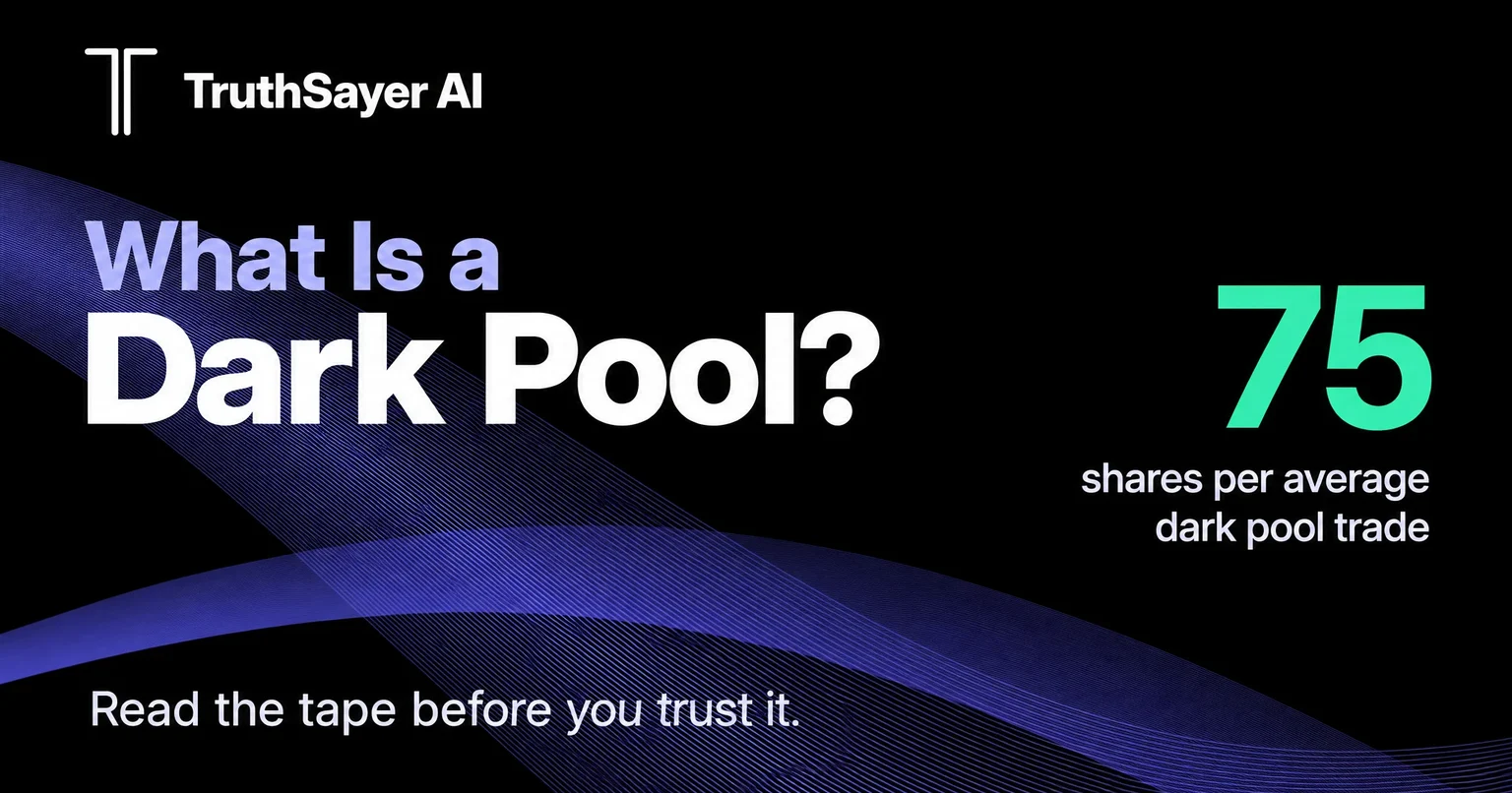
In FINRA's Tier 1 data for the four weeks to October 23, 2026, the average dark pool trade was 75 shares, about $8,519. Most prints are small slices, not blocks.
A print alone is not a buy signal: every trade has a buyer and a seller. Size relative to normal volume and price confirmation matter more.
What is a dark pool and how does dark pool trading work?
A dark pool works like a stock exchange with the order book switched off. Members send buy and sell orders, the pool's software matches them, and nobody outside sees the resting orders. FINRA describes dark pools as venues that do not broadcast pre-trade data, meaning the presence, price and size of orders waiting to trade.
An alternative trading system (ATS) is a trading venue that matches buyers and sellers but is not registered as an exchange. A dark pool is an ATS that does not display quotes. Lit exchanges such as Nasdaq and the NYSE show their bids and offers to everyone.
Most dark pool trades are priced off public exchange quotes. Under the SEC's Order Protection Rule, dark pools generally must execute at prices at least as good as the best publicly available price, FINRA explains. Many trades happen at the midpoint, halfway between the best bid and best offer, so both sides save half the spread.
After the match, the trade is reported to a FINRA Trade Reporting Facility (TRF) and published on the consolidated tape, the real-time feed of all US stock trades. The tape shows the price, size and time. It does not show the buyer, the seller or which side started the trade.
Why do investors use dark pools?
The main reason is market impact. A fund that needs to sell 4 million shares on an exchange would show its hand, and other traders could move the price away before the order finished. In a dark pool, the order rests unseen until a match arrives. The trade-off is uncertainty: the order might fill slowly or not at all.
Who runs dark pools?
Dark pools are run by banks and brokers (UBS ATS, MS Trajectory Cross), independent operators (Intelligent Cross, OneChronos) and block-focused venues (BIDS ATS). Each must file a Form ATS-N with the SEC describing how it operates. The SEC adopted that public disclosure form on July 18, 2018, and the filings are on EDGAR.
How much trading happens in dark pools?
Less than most headlines suggest. Cboe reported that off-exchange trading reached 50.6% of total US stock volume in 2025, the first year it passed half. But 81.3% of that off-exchange volume went through principal dealers, mainly wholesalers that fill retail broker orders, and only 18.7% traded on ATSs. That puts dark pools at roughly 9.5% of all US stock volume (18.7% of 50.6%).
FINRA publishes weekly volume for every ATS, free, after a two- to four-week delay. We pulled the four most recent weeks for Tier 1 stocks, the S&P 500, Russell 1000 and certain ETFs. From September 28 to October 23, 2026, 34 ATSs reported 27.96 billion shares, 371.4 million trades and $3.16 trillion traded. The top 10 handled 76.2% of the shares.
The largest dark pools by share volume, Tier 1 stocks
The share traded on ATSs has grown in recent Octobers. Using the same comparable week each year, here is FINRA's Tier 1 ATS volume against all other off-exchange volume.
| Week of | ATS shares | Other off-exchange shares | ATS share of off-exchange |
|---|---|---|---|
| Oct 17, 2022 | 3.37B | 7.90B | 29.9% |
| Oct 16, 2023 | 3.64B | 7.21B | 33.5% |
| Oct 21, 2024 | 3.77B | 7.03B | 34.9% |
| Oct 20, 2025 | 5.48B | 11.20B | 32.9% |
| Oct 19, 2026 | 7.05B | 11.66B | 37.7% |
One week per year is a snapshot, not a trend line, so read the direction rather than the decimals.
How did one dark pool print turn into a TruthSayer trade?
Here is a real Dark Pools AI trade, taken from the alert and fill records in TruthSayer AI's funded account.
- The print. On May 12, 2026, Dark Pools AI detected one dark pool trade in PayPal (PYPL) of 4,010,000 shares, equal to 28.29% of the stock's average daily volume.
- The confirmation. The model checked price direction and issued a long alert with an entry of $45.49.
- The position. The account bought 35 shares for $1,592.15.
- The exit. The position closed on August 14, 2026, at $59.91, for proceeds of $2,096.85.
- The result. Gross profit was $504.70. After $9.98 in commissions, the net gain was $494.72, or 31.07% in 49 days.
Not every print works. On July 10, 2026, the model flagged a Tesla dark pool trade of 7,711,000 shares, 16% of average daily volume and worth about $2.93 billion. The long entry was $411.21. The trailing stop, set at 3 times the average true range (ATR), a measure of the stock's typical daily move, was hit on November 5 at $368.60, a net loss of 10.97% after 118 days. An IBRX print of 13.4 million shares, 91% of daily volume, ended in a 30.01% loss after 26 days.
Always divide the print size by the stock's average daily volume. Four million shares is routine in Nvidia and enormous in a mid-cap. PayPal's print was 28% of a normal day; that ratio, not the share count, is what made it unusual.
Where does off-exchange volume in big stocks actually trade?
To test how much "dark" volume really comes from dark pools, we pulled FINRA's weekly data for ten heavily traded names for the week of October 19, 2026. For each, we split off-exchange volume into ATS volume and all other off-exchange volume, which is mostly wholesalers and broker internalization.
How much off-exchange volume actually traded in dark pools
In every name we checked, most off-exchange shares did not trade in a dark pool. The ATS share ranged from 23.5% in Intel to 47.0% in the SPY ETF. Retail favorites such as Tesla, Ford and Intel had the lowest ATS share, which fits Cboe's finding that wholesalers handle most off-exchange volume.
Trade size tells the same story. Apple's 508,672 ATS trades that week averaged 54.7 shares, about $18,825 each. Microsoft averaged 41.9 shares and JPMorgan 33.8. Even BIDS ATS, a venue built for blocks, averaged 765 shares per trade over the four weeks.
Method. Data from FINRA's OTC Transparency API, weekly summaries by ATS and by symbol, Tier 1 stocks, retrieved November 10, 2026. ATS share equals ATS shares divided by ATS plus non-ATS off-exchange shares for the same symbol and week. The figures exclude exchange volume.
How do you tell a meaningful dark pool print from noise?
A meaningful print is large relative to normal trading, happens at an informative price and is followed by price movement in one direction. Noise is everything else, which is most prints.
| Check | Meaningful | Probably noise |
|---|---|---|
| Size vs average daily volume | A large share of a normal day in one print (PayPal's was 28%) | A large share count in a mega-cap that trades 50 million shares a day |
| Venue | Reported as an ATS trade | Wholesaler or internalized retail flow mixed into "dark" totals |
| Price | Outside the day's typical range or pressing on a level | At the midpoint, inside a quiet range |
| Instrument | A single stock | An index ETF, where large crosses are routine for creation and hedging |
| Follow-through | Price moves in one direction afterward | Price goes nowhere; the print had a buyer and a seller |
The tape never says who started a trade. A huge print at the bid can be a fund selling or a fund buying from a seller who was in a hurry. Treat direction as unknown until price confirms it.
How do dark pools compare with other ways to follow institutions?
| Source | Delay | What it shows | Weak spot |
|---|---|---|---|
| Dark pool prints on the tape | Seconds | Price, size and time of each off-exchange trade | No buyer, seller or direction; mixed with wholesaler flow |
| FINRA weekly ATS data | 2 to 4 weeks | Volume and trades by ATS and by stock | Too late to trade on; weekly totals only |
| Form 13F filings | Up to 45 days after quarter-end | Holdings of managers with $100 million or more in 13(f) securities | Quarter-end snapshot; Q3 2026 filings are due Nov 16, 2026 |
| Form 4 insider filings | Within 2 business days | Officer, director and 10% holder trades | Covers insiders only, many sales are routine |
| Dark Pools AI signals | Real time alert | Unusually large prints filtered and confirmed by price direction, traded in a funded account | Not every signal works; see the losses above |
Prints are fast but ambiguous. Filings are slow but tell you who owns what. Using both, a print for timing and a filing for context, is better than either alone. Our guide to AI stock signals explains how signal services filter raw data like this.
Which way of using dark pool data is best for you?
Best for swing traders: large prints with price confirmation
If you hold for weeks, focus on prints that are a large share of daily volume and wait for price to confirm. Dark Pools AI positions averaged a 46-day hold, according to the strategy page.
Best for long-term investors: FINRA weekly data and 13F filings
If you hold for years, use the free FINRA data to see whether dark pool activity in a stock is rising, then check the next 13F round for who added shares.
Best for beginners: learn the size ratio first
Before you trust any dark pool alert, practice one calculation: print size divided by average daily volume. It filters out most of the noise on its own.
Who dark pool data is not right for
Day traders who want a direction call within minutes. A print has no side.
Anyone who would trade on a share count without checking average volume.
Investors who will not use a stop. Large prints can fail, as the Tesla and IBRX trades show.
What does dark pool data cost, and how long does it take?
FINRA weekly ATS data: free, two to four weeks old. Checking one stock takes a few minutes.
Real-time prints: they appear on the consolidated tape, so many charting platforms show them. Filtering them by size and venue usually takes a paid data tool or your own scripts.
TruthSayer AI: Dark Pools AI signals are free in the app and on the web. The optional AI chat costs $10.99 a month or $5.99 a month billed annually, after a 7-day trial.
Time per signal: a few minutes to check size, price and follow-through before you act, then a weekly look at the open position.
What are the risks and common mistakes with dark pools?
Calling every off-exchange print a dark pool trade. Most off-exchange volume is wholesaler flow, as our chart shows.
Reading a print as buying. Every share bought was sold by someone. Size is a fact; direction is a guess.
Ignoring ETFs and the close. Index ETF crosses and end-of-day trades often reflect hedging and rebalancing, not a view.
Trusting the venue blindly. Dark pool operators have broken the rules, and the SEC has fined several.
| Date | Firm | Issue | Total paid |
|---|---|---|---|
| Jan 15, 2015 | UBS | Undisclosed order type in its dark pool | More than $14.4 million |
| Aug 12, 2015 | ITG | Secret trading desk using subscriber order data | $20.3 million |
| Jan 31, 2016 | Barclays | Misleading subscribers; admitted wrongdoing | $70 million (SEC and NY Attorney General) |
| Jan 31, 2016 | Credit Suisse | Misleading subscribers about its dark pools | $84.3 million (SEC and NY Attorney General) |
"Dark pools have a significant role in today's equity marketplace, and the firms that run these venues must ensure that they do not make misstatements to subscribers about their material operations."
— Andrew Ceresney, Director of the SEC's Enforcement Division, January 31, 2016
Are dark pools legal?
Yes. Dark pools are legal. They are registered with the SEC as ATSs, overseen by FINRA, required to report every trade and required to disclose their operations on Form ATS-N. The enforcement cases above punished firms for misleading their users, not for running a dark pool.
Are dark pool prints really big institutions buying?
Usually not, and this is where most dark pool content goes wrong. Three facts cut against the story that a print means smart money is loading up.
First, most off-exchange volume is not dark pool volume at all. Second, the average Tier 1 dark pool trade is 75 shares. Institutions slice big orders into small pieces, so a single large print is the exception. Rosenblatt Securities reported in January 2026 that block-focused pools were among the worst performers in 2025, with ATS block market share at new record lows. Third, a print has two sides. A 4-million-share trade means 4 million shares were sold, too.
Large prints can still carry information, as the PayPal trade showed. But the information comes from size relative to normal volume plus what price does next, not from the word "dark." Our article on how to judge a signal service covers the questions to ask any provider that sells dark pool alerts.
How does TruthSayer AI use dark pool data?
TruthSayer AI's Dark Pools AI analyzes market data to detect unusually large institutional transactions, then confirms price direction before it sends an alert, according to the Dark Pools AI page. Entries come within 1 to 2 hours of the alert. Every signal is executed in TruthSayer AI's own funded brokerage account before it is counted.
As of November 10, 2026, the page showed a 33.62% return since inception against 29.44% for the S&P 500, a 67.3% win rate, a 46-day average hold and a beta of 0.91. The trade list showed 304 trades: 206 profitable, 93 losses and 5 open.
Dark Pools AI: closed stock trades by net return
LossProfit
We also computed results from the trade log ourselves, using closed stock trades only. Of 255 closed stock trades from September 27, 2024, to November 5, 2026, 66.3% made money. The median trade returned 1.68% and the mean 2.27%, after commissions. The average win was 9.16% and the average loss 11.29%, so the edge comes from winning more often, not from bigger wins. The median hold was 24 days. Our figures differ from the page's because we count closed stock trades only and report medians. TruthSayer AI reports performance under the Global Investment Performance Standards; see our GIPS page and our guide to GIPS compliance.
How we chose. We used FINRA's own ATS data because it is the official source and free to check. We picked the ten stocks for chart two as heavily traded names across tech, consumer, banking and autos, plus SPY. For the worked example we chose PayPal because it was a clean, closed, single-print trade, and we included the Tesla and IBRX losses so the example is not a highlight reel.
What should you do next? The TruthSayer Dark Pool Print Check
The next step is to run any dark pool print through a fixed checklist before you act. We call it the TruthSayer Dark Pool Print Check.
- Confirm the venue. Make sure it is an ATS trade, not wholesaler flow lumped into "dark" volume.
- Measure the size. Divide the print by average daily volume. The bigger the share of a normal day, the more the print matters.
- Check the instrument. Skip index ETFs and closing crosses unless you know why they traded.
- Wait for confirmation. Let price show a direction before you assume one.
- Set the exit first. Decide your position size and stop before entry.
- Log the result. Track every print you act on, wins and losses, so you know whether it works for you.
To go deeper, read why live-traded signals differ from backtests and whether AI trading is legit. Look up terms in our investing glossary, and see every dark pool trade, open and closed, on the Dark Pools AI page.
The bottom line: A dark pool is a legal, regulated venue that hides orders before a trade, not after. Most off-exchange volume is not dark pool volume, and the average dark pool trade is 75 shares, so a print is not a buy signal on its own. Run the TruthSayer Dark Pool Print Check: confirm the venue, measure size against daily volume, wait for price, and set your stop first.
Frequently asked questions
Can retail investors trade in dark pools?
Not directly in most cases. Dark pool subscribers are usually brokers and institutions. A retail order can end up in a dark pool if your broker routes it there, but most retail orders go to wholesalers. In 2025, principal dealers handled 81.3% of off-exchange volume, according to Cboe.
Are dark pools bad for retail investors?
Not necessarily. Dark pools must generally trade at or better than the best public price, so fills can be fair. The concern is that orders resting in the dark do not help set public prices. FINRA notes that dark pools rely on exchange quotes as their benchmark, so exchanges still matter.
Where can I see dark pool data for free?
FINRA's OTC Transparency site publishes weekly ATS volume by venue and by stock, free, after a two- to four-week delay. Individual dark pool trades also appear on the consolidated tape in real time, so many charting platforms show them, though they rarely separate ATS trades from wholesaler trades.
What should I do after I see a big dark pool print in a stock I own?
Measure the print against average daily volume first. If it is small, ignore it. If it is large, watch the next sessions for price follow-through and check the next 13F filings. Do not change your position on the print alone, because you cannot tell whether it was a buyer or a seller.
How long should I hold a trade based on a dark pool signal?
Set the holding rule before you enter. In our count of 255 closed Dark Pools AI stock trades, the median hold was 24 days, and the strategy page shows a 46-day average. TruthSayer AI exits with a trailing stop, like the 3× ATR stop that closed the Tesla trade, not on a calendar date.
Sources
- FINRA, OTC Transparency data: ATS and non-ATS weekly volume (retrieved Nov 10, 2026; weeks of Oct 17, 2022 to Oct 19, 2026)
- FINRA, "Can You Swim in a Dark Pool?" (Nov 15, 2023)
- Cboe, "2025 U.S. Equities Year in Review" (Jan 2026)
- Rosenblatt Securities, "Let There Be Light: US Edition" (Jan 26, 2026)
- SEC, press release 2018-136: Form ATS-N adopted (Jul 18, 2018)
- SEC, press release 2015-7: UBS dark pool charges (Jan 15, 2015)
- SEC, press release 2015-164: ITG charges (Aug 12, 2015)
- SEC, press release 2016-16: Barclays and Credit Suisse charged with dark pool violations (Jan 31, 2016)
- SEC, Frequently Asked Questions About Form 13F (updated Mar 6, 2026)
- Investor.gov, "Insider Transactions and Forms 3, 4, and 5" (Jan 26, 2021)
- TruthSayer AI, Dark Pools AI performance, trade list and alerts (Nov 10, 2026)
This article is for educational purposes only and is not investment advice. Past performance does not guarantee future results.
Nizar Assanie
Nizar is the founder of TruthSayer AI and brings over two decades of experience in quantitative finance, investment analytics, and machine learning. His expertise spans systematic investment strategies, equity valuation, institutional capital flows, and predictive financial modeling. He leads the development of AI-driven investment strategies designed to identify market inefficiencies and optimize risk-adjusted returns.